Gibbs-Duhem integration: Difference between revisions
Carl McBride (talk | contribs) m (Changed references to Cite format) |
|||
| (15 intermediate revisions by 4 users not shown) | |||
| Line 1: | Line 1: | ||
The so-called '''Gibbs-Duhem integration''' refers to a number of methods that couple | |||
molecular [[Computer simulation techniques |simulation techniques]] with [[Thermodynamic relations |thermodynamic equations]] in order to draw | |||
The so-called Gibbs-Duhem | [[Computation of phase equilibria | phase coexistence]] lines. The original method was proposed by David Kofke <ref>[http://dx.doi.org/10.1080/00268979300100881 David A. Kofke, "Gibbs-Duhem integration: a new method for direct evaluation of phase coexistence by molecular simulation", Molecular Physics '''78''' pp 1331 - 1336 (1993)]</ref> | ||
molecular simulation techniques with thermodynamic equations in order to draw | <ref>[http://dx.doi.org/10.1063/1.465023 David A. Kofke, "Direct evaluation of phase coexistence by molecular simulation via integration along the saturation line", Journal of Chemical Physics '''98''' pp. 4149-4162 (1993)]</ref>. | ||
phase coexistence lines. | |||
The method was proposed by Kofke ( | |||
== Basic Features == | == Basic Features == | ||
Consider two thermodynamic phases: <math> a </math> and <math> b </math>, at thermodynamic equilibrium at certain conditions. | Consider two thermodynamic phases: <math> a </math> and <math> b </math>, at thermodynamic equilibrium at certain conditions. Thermodynamic equilibrium implies: | ||
* Equal temperature in both phases: <math> T = T_{a} = T_{b} </math>, i.e. thermal | * Equal [[temperature]] in both phases: <math> T = T_{a} = T_{b} </math>, i.e. thermal equilibrium. | ||
* Equal pressure in both phases <math> p = p_{a} = p_{b} </math>, i.e. mechanical | * Equal [[pressure]] in both phases <math> p = p_{a} = p_{b} </math>, i.e. mechanical equilibrium. | ||
* Equal chemical | * Equal [[chemical potential]]s for the components <math> \mu_i = \mu_{ia} = \mu_{ib} </math>, i.e. ''material'' equilibrium. | ||
In addition if | In addition, if one is dealing with a statistical mechanical [[models |model]], having certain parameters that can be represented as <math> \lambda </math>, then the | ||
model should be the same in both phases. | model should be the same in both phases. | ||
| Line 31: | Line 27: | ||
where | where | ||
* <math> \beta = 1/k_B T </math>, where <math> k_B </math> is the [[Boltzmann constant]] | * <math> \beta := 1/k_B T </math>, where <math> k_B </math> is the [[Boltzmann constant]] | ||
When a differential change of the conditions is performed | When a differential change of the conditions is performed one will have, for any phase: | ||
: <math> d \left( \beta\mu \right) = \left[ \frac{ \partial (\beta \mu) }{\partial \beta} \right]_{\beta p,\lambda} d \beta + | : <math> d \left( \beta\mu \right) = \left[ \frac{ \partial (\beta \mu) }{\partial \beta} \right]_{\beta p,\lambda} d \beta + | ||
| Line 39: | Line 35: | ||
</math> | </math> | ||
Taking into account that <math> \mu </math> is the [[Gibbs energy function | Taking into account that <math> \mu </math> is the [[Gibbs energy function]] per particle | ||
: <math> d \left( \beta\mu \right) = \frac{E}{N} d \beta + \frac{ V }{N } d (\beta p) + | : <math> d \left( \beta\mu \right) = \frac{E}{N} d \beta + \frac{ V }{N } d (\beta p) + | ||
\left[ \frac{ \partial (\beta \mu) }{\partial \lambda} \right]_{\beta,\beta p} d \lambda. | \left[ \frac{ \partial (\beta \mu) }{\partial \lambda} \right]_{\beta,\beta p} d \lambda. | ||
| Line 45: | Line 41: | ||
where: | where: | ||
* <math> \left. E \right. </math> is the internal energy | * <math> \left. E \right. </math> is the [[internal energy]] (sometimes written as <math>U</math>). | ||
* <math> \left. V \right. </math> is the volume | * <math> \left. V \right. </math> is the volume | ||
* <math> \left. N \right. </math> is the number of particles | * <math> \left. N \right. </math> is the number of particles | ||
<math> \left. \right. E, V </math> are the mean values of the energy and volume for a system of <math> \left. N \right. </math> particles | |||
in the isothermal-isobaric ensemble | |||
Let us use a bar to design quantities divided by the number of particles: e.g. <math> \bar{E} = E/N; \bar{V} = V/N </math>; | Let us use a bar to design quantities divided by the number of particles: e.g. <math> \bar{E} = E/N; \bar{V} = V/N </math>; | ||
and taking into account the definition: | and taking into account the definition: | ||
: <math> \bar{L} \equiv | : <math> \bar{L} \equiv \left[ \frac {\partial (\beta \mu )}{\partial \lambda }\right]_{\beta,\beta p} </math> | ||
Again, let us suppose that we have a phase coexistence at a point given by <math>\left[ \beta_0, (\beta p)_0, \lambda_0 \right]</math> and that | Again, let us suppose that we have a phase coexistence at a point given by <math>\left[ \beta_0, (\beta p)_0, \lambda_0 \right]</math> and that | ||
| Line 64: | Line 63: | ||
constrained to fulfill: | constrained to fulfill: | ||
<math> \left( \Delta \bar{E} \right) d \beta + \left( \Delta \bar{V} \right) d (\beta p) + \left(\Delta \bar{L} \right) d \lambda = 0 </math> | :<math> \left( \Delta \bar{E} \right) d \beta + \left( \Delta \bar{V} \right) d (\beta p) + \left(\Delta \bar{L} \right) d \lambda = 0 </math> | ||
where for any property <math> X </math> we can define: <math> \Delta X \equiv X_a - X_b </math> (i.e. the difference between the values of the property in the phases). | |||
Taking a path with, for instance | Taking a path with, for instance constant <math> \beta </math>, the coexistence line will follow the trajectory produced by the solution of the | ||
differential equation: | differential equation: | ||
<math> d(\beta p) = - \frac{ \Delta \bar{L} }{\Delta \bar{V} } d \lambda. </math> (Eq. 1) | :<math> d(\beta p) = - \frac{ \Delta \bar{L} }{\Delta \bar{V} } d \lambda. </math> (Eq. 1) | ||
The Gibbs-Duhem integration technique, for this example, will be a numerical procedure covering the following tasks: | The Gibbs-Duhem integration technique, for this example, will be a numerical procedure covering the following tasks: | ||
* Computer simulation (for instance using [[Metropolis Monte Carlo]] in the NpT ensemble) runs to estimate the values of <math> \bar{L}, \bar{V} </math> for both | * Computer simulation (for instance using [[Metropolis Monte Carlo]] in the [[Isothermal-isobaric ensemble |NpT ensemble]]) runs to estimate the values of <math> \bar{L}, \bar{V} </math> for both | ||
phases at given values of <math> [\beta, \beta p, \lambda ] </math>. | phases at given values of <math> [\beta, \beta p, \lambda ] </math>. | ||
| Line 81: | Line 80: | ||
== Peculiarities of the method (Warnings) == | == Peculiarities of the method (Warnings) == | ||
* A good initial point must be known to start the procedure | * A good initial point must be known to start the procedure (See <ref>[http://dx.doi.org/10.1063/1.2137705 A. van 't Hof, S. W. de Leeuw, and C. J. Peters "Computing the starting state for Gibbs-Duhem integration", Journal of Chemical Physics '''124''' 054905 (2006)]</ref> and [[computation of phase equilibria]]). | ||
* The ''integrand'' of the differential equation is computed with some numerical uncertainty | * The ''integrand'' of the differential equation is computed with some numerical uncertainty | ||
| Line 88: | Line 87: | ||
== References == | == References == | ||
<references/> | |||
'''Related reading''' | |||
*[http://dx.doi.org/10.1063/1.2137706 A. van 't Hof, C. J. Peters, and S. W. de Leeuw "An advanced Gibbs-Duhem integration method: Theory and applications", Journal of Chemical Physics '''124''' 054906 (2006)] | |||
*[http://dx.doi.org/10.1063/1.3486090 Gerassimos Orkoulas "Communication: Tracing phase boundaries via molecular simulation: An alternative to the Gibbs–Duhem integration method", Journal of Chemical Physics '''133''' 111104 (2010)] | |||
[[category: computer simulation techniques]] | |||
Latest revision as of 13:02, 28 September 2010
The so-called Gibbs-Duhem integration refers to a number of methods that couple molecular simulation techniques with thermodynamic equations in order to draw phase coexistence lines. The original method was proposed by David Kofke [1] [2].
Basic Features[edit]
Consider two thermodynamic phases: and Failed to parse (SVG (MathML can be enabled via browser plugin): Invalid response ("Math extension cannot connect to Restbase.") from server "https://wikimedia.org/api/rest_v1/":): {\displaystyle b } , at thermodynamic equilibrium at certain conditions. Thermodynamic equilibrium implies:

- Equal temperature in both phases: Failed to parse (SVG (MathML can be enabled via browser plugin): Invalid response ("Math extension cannot connect to Restbase.") from server "https://wikimedia.org/api/rest_v1/":): {\displaystyle T = T_{a} = T_{b} } , i.e. thermal equilibrium.
- Equal pressure in both phases Failed to parse (SVG (MathML can be enabled via browser plugin): Invalid response ("Math extension cannot connect to Restbase.") from server "https://wikimedia.org/api/rest_v1/":): {\displaystyle p = p_{a} = p_{b} } , i.e. mechanical equilibrium.
- Equal chemical potentials for the components Failed to parse (SVG (MathML can be enabled via browser plugin): Invalid response ("Math extension cannot connect to Restbase.") from server "https://wikimedia.org/api/rest_v1/":): {\displaystyle \mu_i = \mu_{ia} = \mu_{ib} } , i.e. material equilibrium.
In addition, if one is dealing with a statistical mechanical model, having certain parameters that can be represented as Failed to parse (SVG (MathML can be enabled via browser plugin): Invalid response ("Math extension cannot connect to Restbase.") from server "https://wikimedia.org/api/rest_v1/":): {\displaystyle \lambda } , then the model should be the same in both phases.
Example: phase equilibria of one-component system[edit]
Notice: The derivation that follows is just a particular route to perform the integration
- Consider that at given conditions of Failed to parse (SVG (MathML can be enabled via browser plugin): Invalid response ("Math extension cannot connect to Restbase.") from server "https://wikimedia.org/api/rest_v1/":): {\displaystyle T , p, \lambda } two phases of the systems are at equilibrium, this implies:
- Failed to parse (SVG (MathML can be enabled via browser plugin): Invalid response ("Math extension cannot connect to Restbase.") from server "https://wikimedia.org/api/rest_v1/":): {\displaystyle \mu_{a} \left( T, p, \lambda \right) = \mu_{b} \left( T, p, \lambda \right) }
Given the thermal equilibrium we can also write:
- Failed to parse (SVG (MathML can be enabled via browser plugin): Invalid response ("Math extension cannot connect to Restbase.") from server "https://wikimedia.org/api/rest_v1/":): {\displaystyle \beta \mu_{a} \left( \beta, \beta p, \lambda \right) = \beta \mu_{b} \left( \beta, \beta p, \lambda \right) }
where
- Failed to parse (SVG (MathML can be enabled via browser plugin): Invalid response ("Math extension cannot connect to Restbase.") from server "https://wikimedia.org/api/rest_v1/":): {\displaystyle \beta := 1/k_B T } , where Failed to parse (SVG (MathML can be enabled via browser plugin): Invalid response ("Math extension cannot connect to Restbase.") from server "https://wikimedia.org/api/rest_v1/":): {\displaystyle k_B } is the Boltzmann constant
When a differential change of the conditions is performed one will have, for any phase:
- Failed to parse (SVG (MathML can be enabled via browser plugin): Invalid response ("Math extension cannot connect to Restbase.") from server "https://wikimedia.org/api/rest_v1/":): {\displaystyle d \left( \beta\mu \right) = \left[ \frac{ \partial (\beta \mu) }{\partial \beta} \right]_{\beta p,\lambda} d \beta + \left[ \frac{ \partial (\beta \mu) }{\partial (\beta p)} \right]_{\beta,\lambda} d (\beta p) + \left[ \frac{ \partial (\beta \mu) }{\partial \lambda} \right]_{\beta,\beta p} d \lambda. }
Taking into account that is the Gibbs energy function per particle

- Failed to parse (SVG (MathML can be enabled via browser plugin): Invalid response ("Math extension cannot connect to Restbase.") from server "https://wikimedia.org/api/rest_v1/":): {\displaystyle d \left( \beta\mu \right) = \frac{E}{N} d \beta + \frac{ V }{N } d (\beta p) + \left[ \frac{ \partial (\beta \mu) }{\partial \lambda} \right]_{\beta,\beta p} d \lambda. }
where:
- Failed to parse (SVG (MathML can be enabled via browser plugin): Invalid response ("Math extension cannot connect to Restbase.") from server "https://wikimedia.org/api/rest_v1/":): {\displaystyle \left. E \right. } is the internal energy (sometimes written as Failed to parse (SVG (MathML can be enabled via browser plugin): Invalid response ("Math extension cannot connect to Restbase.") from server "https://wikimedia.org/api/rest_v1/":): {\displaystyle U} ).
- Failed to parse (SVG (MathML can be enabled via browser plugin): Invalid response ("Math extension cannot connect to Restbase.") from server "https://wikimedia.org/api/rest_v1/":): {\displaystyle \left. V \right. } is the volume
- is the number of particles

Failed to parse (SVG (MathML can be enabled via browser plugin): Invalid response ("Math extension cannot connect to Restbase.") from server "https://wikimedia.org/api/rest_v1/":): {\displaystyle \left. \right. E, V } are the mean values of the energy and volume for a system of Failed to parse (SVG (MathML can be enabled via browser plugin): Invalid response ("Math extension cannot connect to Restbase.") from server "https://wikimedia.org/api/rest_v1/":): {\displaystyle \left. N \right. } particles in the isothermal-isobaric ensemble
Let us use a bar to design quantities divided by the number of particles: e.g. Failed to parse (SVG (MathML can be enabled via browser plugin): Invalid response ("Math extension cannot connect to Restbase.") from server "https://wikimedia.org/api/rest_v1/":): {\displaystyle \bar{E} = E/N; \bar{V} = V/N } ; and taking into account the definition:
- Failed to parse (SVG (MathML can be enabled via browser plugin): Invalid response ("Math extension cannot connect to Restbase.") from server "https://wikimedia.org/api/rest_v1/":): {\displaystyle \bar{L} \equiv \left[ \frac {\partial (\beta \mu )}{\partial \lambda }\right]_{\beta,\beta p} }
Again, let us suppose that we have a phase coexistence at a point given by Failed to parse (SVG (MathML can be enabled via browser plugin): Invalid response ("Math extension cannot connect to Restbase.") from server "https://wikimedia.org/api/rest_v1/":): {\displaystyle \left[ \beta_0, (\beta p)_0, \lambda_0 \right]} and that we want to modify slightly the conditions. In order to keep the system at the coexistence conditions:
- Failed to parse (SVG (MathML can be enabled via browser plugin): Invalid response ("Math extension cannot connect to Restbase.") from server "https://wikimedia.org/api/rest_v1/":): {\displaystyle d \left[ \beta \mu_{a} - \beta \mu_b \right] = 0 }
Therefore, to keep the system on the coexistence conditions, the changes in the variables Failed to parse (SVG (MathML can be enabled via browser plugin): Invalid response ("Math extension cannot connect to Restbase.") from server "https://wikimedia.org/api/rest_v1/":): {\displaystyle \beta, (\beta p), \lambda } are constrained to fulfill:
- Failed to parse (SVG (MathML can be enabled via browser plugin): Invalid response ("Math extension cannot connect to Restbase.") from server "https://wikimedia.org/api/rest_v1/":): {\displaystyle \left( \Delta \bar{E} \right) d \beta + \left( \Delta \bar{V} \right) d (\beta p) + \left(\Delta \bar{L} \right) d \lambda = 0 }
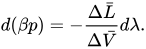
where for any property Failed to parse (SVG (MathML can be enabled via browser plugin): Invalid response ("Math extension cannot connect to Restbase.") from server "https://wikimedia.org/api/rest_v1/":): {\displaystyle X } we can define: Failed to parse (SVG (MathML can be enabled via browser plugin): Invalid response ("Math extension cannot connect to Restbase.") from server "https://wikimedia.org/api/rest_v1/":): {\displaystyle \Delta X \equiv X_a - X_b } (i.e. the difference between the values of the property in the phases). Taking a path with, for instance constant Failed to parse (SVG (MathML can be enabled via browser plugin): Invalid response ("Math extension cannot connect to Restbase.") from server "https://wikimedia.org/api/rest_v1/":): {\displaystyle \beta } , the coexistence line will follow the trajectory produced by the solution of the differential equation:
- (Eq. 1)
The Gibbs-Duhem integration technique, for this example, will be a numerical procedure covering the following tasks:
- Computer simulation (for instance using Metropolis Monte Carlo in the NpT ensemble) runs to estimate the values of Failed to parse (SVG (MathML can be enabled via browser plugin): Invalid response ("Math extension cannot connect to Restbase.") from server "https://wikimedia.org/api/rest_v1/":): {\displaystyle \bar{L}, \bar{V} } for both
phases at given values of Failed to parse (SVG (MathML can be enabled via browser plugin): Invalid response ("Math extension cannot connect to Restbase.") from server "https://wikimedia.org/api/rest_v1/":): {\displaystyle [\beta, \beta p, \lambda ] } .
- A procedure to solve numerically the differential equation (Eq.1)
Peculiarities of the method (Warnings)[edit]
- A good initial point must be known to start the procedure (See [3] and computation of phase equilibria).
- The integrand of the differential equation is computed with some numerical uncertainty
- Care must be taken to reduce (and estimate) possible departures from the correct coexistence lines
References[edit]
- ↑ David A. Kofke, "Gibbs-Duhem integration: a new method for direct evaluation of phase coexistence by molecular simulation", Molecular Physics 78 pp 1331 - 1336 (1993)
- ↑ David A. Kofke, "Direct evaluation of phase coexistence by molecular simulation via integration along the saturation line", Journal of Chemical Physics 98 pp. 4149-4162 (1993)
- ↑ A. van 't Hof, S. W. de Leeuw, and C. J. Peters "Computing the starting state for Gibbs-Duhem integration", Journal of Chemical Physics 124 054905 (2006)
Related reading
- A. van 't Hof, C. J. Peters, and S. W. de Leeuw "An advanced Gibbs-Duhem integration method: Theory and applications", Journal of Chemical Physics 124 054906 (2006)
- Gerassimos Orkoulas "Communication: Tracing phase boundaries via molecular simulation: An alternative to the Gibbs–Duhem integration method", Journal of Chemical Physics 133 111104 (2010)