1-dimensional Ising model
The 1-dimensional Ising model is an Ising model that consists of a system with spins in a row. The energy of the system is given by

- ,
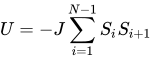
where each variable can be either -1 or +1.

The partition function of the system will be:
- ,
![{\displaystyle Q_{N}=\sum _{\Omega ^{N}}\exp \left[K\sum _{i=1}^{N-1}S_{i}S_{i+1}\right]}](https://wikimedia.org/api/rest_v1/media/math/render/svg/a1419d045395f90f5727c9e80f5550a0aa103109)
where represents the possible configuration of the N spins of the system,
and


- Failed to parse (Conversion error. Server ("https://wikimedia.org/api/rest_") reported: "Cannot get mml. Server problem."): {\displaystyle Q_{N}=\sum _{S_{1}}\sum _{S_{2}}e^{KS_{1}S_{2}}\sum _{S_{3}}e^{KS_{2}S_{3}}\cdots \sum _{S_{N-1}}e^{KS_{N-2}S_{N-1}}\sum _{S_{N}}e^{KS_{N-1}S_{N}}}
Performing the sum of the possible values of Failed to parse (Conversion error. Server ("https://wikimedia.org/api/rest_") reported: "Cannot get mml. Server problem."): {\displaystyle S_{N}} we get:
- Failed to parse (Conversion error. Server ("https://wikimedia.org/api/rest_") reported: "Cannot get mml. Server problem."): {\displaystyle Q_{N}=\sum _{S_{1}}\sum _{S_{2}}e^{KS_{1}S_{2}}\sum _{S_{3}}e^{KS_{2}S_{3}}\cdots \sum _{S_{N-2}}e^{KS_{N-2}S_{N-1}}\left[2\cosh(KS_{N-1})\right]}
Taking into account that

![{\displaystyle Q_{N}=\sum _{S_{1}}\sum _{S_{2}}e^{KS_{1}S_{2}}\sum _{S_{3}}e^{KS_{2}S_{3}}\cdots \sum _{S_{N-1}}e^{KS_{N-2}S_{N-1}}\left[2\cosh(K)\right]}](https://wikimedia.org/api/rest_v1/media/math/render/svg/cb95f34f38cb6fb130eb06e3ab9a81daad4a2074)
Therefore:


The Helmholtz energy function in the thermodynamic limit will be
- Failed to parse (SVG (MathML can be enabled via browser plugin): Invalid response ("Math extension cannot connect to Restbase.") from server "https://wikimedia.org/api/rest_v1/":): {\displaystyle A = - N k_B T \log \left( 2 \cosh K \right) }
References
- Rodney J. Baxter "Exactly Solved Models in Statistical Mechanics", Academic Press (1982) ISBN 0120831821 Chapter 2 (freely available pdf)